

Dental lab transition planning is the structured process of moving a lab from paper notes, spreadsheets, and disconnected tools toward a more organized digital workflow. For most small and medium labs, the goal is not to “go fully digital” overnight. The goal is to make the transition in a controlled way: clean up how cases are tracked, define who owns each step, train the team, migrate important data, and only then add more advanced tools such as CAD/CAM, 3D printing, or lab management software. Done well, transition planning reduces confusion and gives the lab owner better visibility into cases, deadlines, deliveries, and payments.
What are the key phases in dental lab transition planning?
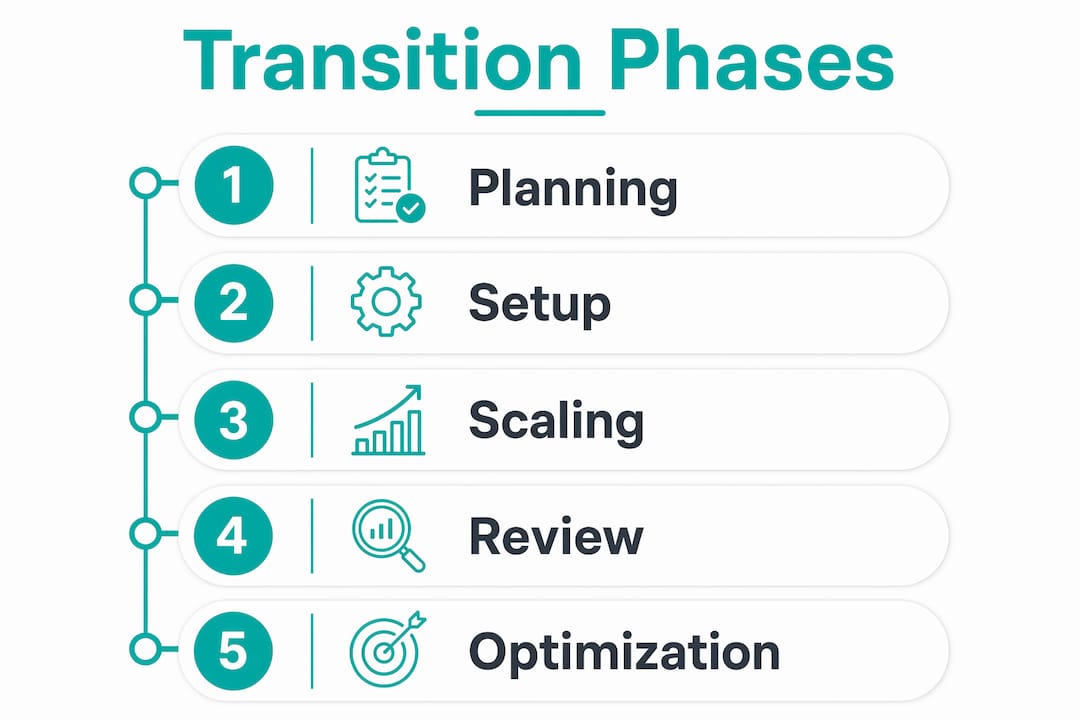
Dental lab transition planning follows three distinct phases: planning, setup, and scaling. Each phase has specific goals, and skipping steps in any one of them is the most common reason transitions fail.
Phase 1: Planning (Weeks 1 to 2)
This phase is where you define scope, select partners, and audit your current workflows. You identify which cases will move to digital first, which staff members need training, and what software or equipment you need to procure. Partner selection matters here. Strategic partner selection and SOP standardization are the two factors most responsible for sustaining quality and delivery performance after go-live.
Phase 2: Setup (Weeks 3 to 4)
Equipment arrives, software gets configured, and your team runs pilot cases. This is also when you establish your standard operating procedures and quality control checkpoints. Pilot projects should start with 10 to 20 cases using limited case types to refine your SOPs before volume increases. Rushing past this phase is the single biggest cause of early-stage failures.
Phase 3: Scaling (Weeks 5 to 8)
Full deployment begins, and you start tracking performance against your own KPIs. This is when parallel workflows become important, and when your lab management system should help the team see case status, due dates, delivery status, and payment status without chasing information across paper notes and spreadsheets.
Pro Tip: Build a formal review checkpoint at the end of each phase. A 30-minute team debrief after weeks 2, 4, and 8 catches problems before they compound into costly rework.
How to manage traditional and digital workflows during lab transition?
Running traditional and digital workflows side by side is not inefficiency. It is risk management. Parallel workflows for 60 to 90 days build team confidence without compromising patient care, and they give you a fallback if a digital case hits an unexpected snag.
Here is what effective parallel workflow management looks like in practice:
- Assign case types deliberately. Route straightforward single-unit restorations through the digital workflow first. Keep complex multi-unit cases on traditional methods until your team’s digital accuracy is proven.
- Keep tracking consistent. During the transition window, make it very clear where each type of case is tracked. Avoid letting one team use paper, another use spreadsheets, and another use software without a shared view of what is actually due.
- Schedule weekly cross-team reviews. Bring your lead technicians together every week to compare output quality, flag recurring issues, and document what is working. This builds buy-in and surfaces training gaps early.
- Communicate proactively with referring dentists. Let your dental practice partners know you are transitioning. Most will appreciate the transparency, and some will actively support your digital adoption by submitting digital scans rather than physical impressions.
During this parallel period, communication discipline matters as much as technology. Whether you use a portal, email, or a lab management tool, every case should have one clear place where notes, due dates, delivery status, and client communication are recorded.
Pro Tip: Designate one senior technician as your “digital workflow lead” during the parallel period. This person owns quality checks on all digital cases and becomes your internal expert as volume scales up.
What performance indicators measure the success of dental lab transitions?
You cannot manage what you do not measure. Digital transformation works as a profitability lever only when you track the right KPIs and act on what they tell you.
The three metrics that matter most during and after a dental lab transition are:
| KPI | Target | What it tells you |
|---|---|---|
| Remake rate | Lower than your current baseline | Measures case accuracy and SOP effectiveness |
| On-time delivery | Consistently improving | Reflects workflow reliability and scheduling discipline |
| Contact adjustments | Tracked and reduced over time | Indicates fit precision and digital scanning quality |
The exact targets will depend on your lab, your case mix, and your baseline performance. The important part is to track the same numbers consistently before, during, and after the transition. A lab that adopts digital tools but sees remake rates climb has not solved the underlying workflow problem.
Track these metrics weekly during the first 90 days of your transition, then shift to monthly reviews once performance stabilizes. If you are still pulling numbers manually from multiple spreadsheets, treat that as a sign that your workflow is not centralized enough yet.
Financial KPIs matter too. Track cost per case, time spent on admin work, delayed invoices, and missed delivery dates before and after the transition. These numbers give a more realistic picture of ROI than any generic industry benchmark.
What practical steps enable successful integration of digital tools?
The technology itself is rarely the obstacle. The obstacle is the process around the technology. Here is how to get the integration right.
Choose your tools based on your current case mix
A lab producing primarily full-arch dentures has different equipment needs than one focused on single-unit crowns. The right technology depends on your current case mix, staff skills, dentist relationships, and budget. Do not buy equipment because it looks impressive. Buy it because it solves a specific bottleneck in your workflow.
For small labs with limited capital, a hybrid model often works well. You can start by improving case tracking, standardizing intake, and outsourcing selected digital manufacturing steps before making larger equipment purchases.
Build your SOP library before you scale
Every digital workflow step needs a written procedure. This includes file naming conventions, scan acceptance criteria, design review checkpoints, and output quality standards. Labs that scale without formal SOPs see high failure rates in the first weeks of full deployment. SOPs are not bureaucracy. They are the reason your digital cases come out right the second time, not just the first.
Address data migration as a standalone project
Dental lab data migration is often treated as an afterthought. It should be treated as its own workstream. Moving case histories, client records, pricing structures, and pricing and client data from spreadsheets or legacy software into a modern lab management platform takes time and requires validation. Assign one person to own data migration, set a completion deadline before go-live, and run a parallel check to confirm that migrated records match your source data.
Invest in staff training with real case volume
Training on dummy cases does not prepare technicians for production pressure. Run your training program on actual low-complexity cases with a supervisor present. Digital denture workflows closely mirror traditional lab steps but improve precision, which means experienced technicians adapt faster than you might expect. The learning curve is real but short when training uses live work.
You can also reduce your administrative load significantly during this period by using tools designed for reducing admin workload, freeing your team to focus on production quality rather than paperwork.
Key takeaways
Dental lab transition planning succeeds when it follows a phased structure, tracks defined KPIs, and keeps traditional workflows running in parallel until digital accuracy is proven.
| Point | Details |
|---|---|
| Use a three-phase roadmap | Plan, setup, and scale in sequence to reduce risk and build team confidence. |
| Run parallel workflows for 60 to 90 days | Maintain traditional methods alongside digital ones until KPIs confirm readiness to fully switch. |
| Track remake rate and on-time delivery | Target under 3% remakes and above 95% on-time delivery to validate transition success. |
| Start pilots with 10 to 20 cases | Small-scale pilots let you refine SOPs before committing to full production volume. |
| Treat data migration as its own project | Assign ownership, set a deadline, and validate migrated records before going live. |
What I’ve learned from watching labs rush their transitions
Most dental lab transitions that struggle share one common trait: the owner treated the technology purchase as the finish line instead of the starting line. I have seen labs invest in CAD/CAM systems and 3D printers, then watch their remake rates climb because nobody built the SOPs to support the new equipment. The hardware is the easy part. The operational discipline is what actually determines outcomes.
The other mistake I see consistently is skipping staff buy-in. Technicians who feel like digital workflows are being imposed on them find ways to work around them. The labs that transition smoothly are the ones where senior technicians are involved in tool selection, pilot design, and SOP development from week one. That involvement creates ownership, and ownership creates accountability.
One thing that rarely gets discussed: plan your equipment upgrade cycle before you buy. Digital equipment requires upgrade planning every 5 to 7 years to stay competitive. If your capital plan does not account for that, you will find yourself back at square one in less time than you expect.
The labs I respect most are the ones that treat transition as a continuous process, not a project with an end date. They review their KPIs monthly, adjust their SOPs when metrics slip, and stay curious about what the next generation of tools can do for their specific case mix. That mindset is what separates labs that grow from labs that stagnate.
How Dental Lab Guru supports your lab’s transition
A transition is much easier when the team has one reliable place to see what is happening in the lab. Dental Lab Guru is designed for small and medium dental labs that want to move away from scattered spreadsheets, paper notes, and memory-based tracking.
Dental Lab Guru helps you organize cases, clients, deadlines, deliveries, and payments in one system. During a transition, that gives your team a clearer foundation before adding more complex digital tools. You can start by tracking active cases properly, making due dates visible, and keeping delivery and payment status easier to find. If your lab is preparing to move from manual tracking to a more organized workflow, try Dental Lab Guru and see whether it fits the way your lab works.
FAQ
What is dental lab transition planning?
Dental lab transition planning is the structured process of moving a dental laboratory from manual or paper-based operations to digital workflows, covering technology selection, staff training, data migration, and phased implementation.
How long does a dental lab digital transition take?
A simple transition can be planned in phases over several weeks, but the full adjustment period often takes longer. Many labs benefit from keeping traditional and digital workflows running in parallel for 60 to 90 days while the team builds confidence.
What KPIs should I track during a dental lab transition?
Track remake rate, on-time delivery, contact adjustments, delayed cases, and admin time. The exact target depends on your starting point, but the direction should be clear: fewer remakes, fewer late cases, and less time spent chasing information.
How do small labs manage the cost of going digital?
Small labs can manage the cost by starting with workflow improvements first, then adding digital tools in stages. A hybrid model, where some production steps are outsourced while the lab builds internal capability, can also reduce upfront risk.
What is the biggest risk in dental lab digital transformation?
Scaling too fast without formal SOPs is the leading cause of transition failures. Starting with 10 to 20 pilot cases, refining your procedures, and validating quality before increasing volume prevents the high remake rates that undermine ROI in the early weeks of deployment.