

A dental lab purchase order is a buyer-issued document that authorizes the purchase of products or services from a supplier. It usually includes quantities, prices, delivery dates, payment terms, and the people responsible for the order. In dental labs, it is important to separate this from a clinical lab prescription. The prescription tells the technician what to make. The purchase order explains what is being bought, from whom, at what price, and under what terms.
What is a dental lab purchase order and why does it matter?
A dental lab purchase order is the formal procurement authorization your office or lab issues before any goods or services change hands. It is not a receipt, not a prescription, and not an invoice. It is the document that defines the transaction before it happens.
The purchase order specifies terms before the work or supply order begins. That prevents misunderstandings and gives the lab a simple way to track what was ordered, when it was expected, and how it should be billed. For dental labs, this matters because procurement errors, wrong materials, incorrect quantities, or missed delivery dates can quickly turn into delayed cases and unhappy dentists.
The PO also functions as a financial control tool. When your lab issues a PO, you are committing budget to a specific purchase. That commitment is documented, traceable, and auditable. For small to medium labs managing multiple suppliers and case types simultaneously, this level of documentation is not optional. It is how you stay in control.
What key elements are included in a dental lab purchase order?
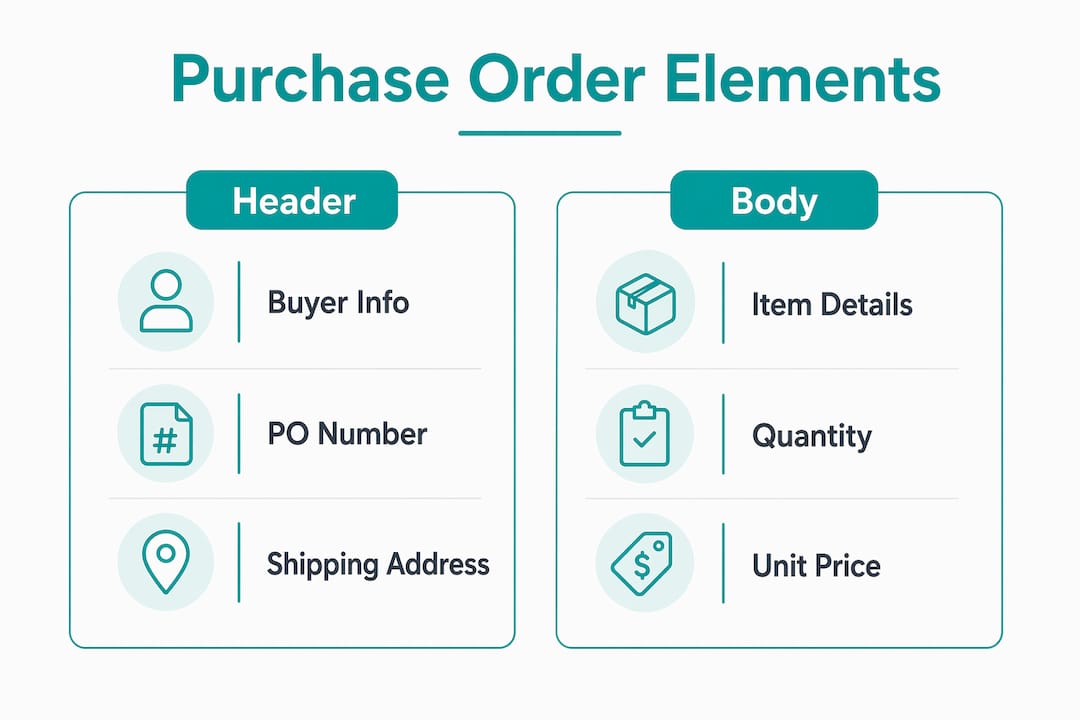
A standardized purchase order follows a header, body, and footer structure. Each section carries specific information that protects both the buyer and the vendor.
Here is what every dental lab purchase order should include:
- Buyer and seller information: Full legal names, addresses, phone numbers, and contact persons for both the dental office or lab and the supplier.
- Unique PO number and date: The PO number is the single most important identifier in the document. It links the order to invoices, delivery receipts, and case records.
- Itemized product or service list: Each line item should include a description, quantity, unit of measure, unit price, and line total.
- Delivery schedule and shipping terms: Specify the expected delivery date, shipping method, and who bears shipping costs.
- Payment terms and conditions: Net 30, Net 60, or any agreed discount structure should appear clearly in the footer.
- Authorized signature or approval: Confirms the purchase has been reviewed and approved internally before being sent to the vendor.
The table below shows how these elements map to the three structural sections of a standard PO:
| PO Section | Elements Included |
|---|---|
| Header | Buyer/seller info, PO number, date, shipping address |
| Body | Itemized list with descriptions, quantities, units, and pricing |
| Footer | Payment terms, delivery schedule, authorized signature |
Clarity in each section prevents disputes. A vague line item like "dental supplies" creates room for error. A specific entry like "IPS e.max CAD LT A2 C14, 5 units, $42.00 each" leaves no room for interpretation.
Pro Tip: Always assign PO numbers using a consistent format, such as LAB-2026-0001, so you can sort and search orders by year and sequence without confusion.
How does a dental lab purchase order differ from a lab prescription?
This is the most common source of confusion in dental procurement. A dental lab prescription, also called a work authorization, is a clinical instruction document. It tells the lab technician what prosthesis to fabricate, what materials to use, what shade to apply, and what the patient's bite specifications are. A purchase order, by contrast, is a financial and contractual document. It tells the supplier what to deliver, at what price, and under what terms.
Both documents are necessary. They serve different but complementary purposes. The lab prescription protects clinical compliance and correctness. The purchase order protects financial accountability and procurement integrity. Confusing the two, or using one in place of the other, creates gaps in both clinical and financial records.
The table below clarifies the key distinctions:
| Feature | Lab Prescription / Work Authorization | Dental Lab Purchase Order |
|---|---|---|
| Purpose | Clinical fabrication instructions | Procurement authorization |
| Issued by | Dentist | Dental office or lab manager |
| Contains | Patient info, materials, design specs | Pricing, quantities, delivery, payment terms |
| Legal function | Compliance and clinical record | Commercial record / purchasing agreement |
| Required by law? | Yes, in most jurisdictions | Best practice, not always mandated |
Practitioners who separate clinical scope from financial procurement track cases better and reduce payment mismatches. The most effective way to align both documents is to include a shared case or job identifier on both the prescription and the PO. That single cross-reference makes matching invoices to cases fast and error-free.
Pro Tip: Add your internal case number to both the lab prescription and the purchase order. This one step eliminates the most common source of invoice matching delays.
What is the typical process for creating and managing dental lab purchase orders?
Creating a purchase order is straightforward when the lab follows the same process every time. A simple workflow is enough:
- Identify the need. Determine what products or services are required, the quantities needed, and the timeline for delivery. This step often connects directly to an active patient case or a scheduled production run.
- Draft the purchase order. Use a standardized template or dental lab management software to populate all required fields. Assign a unique PO number using your lab's numbering convention.
- Review terms and pricing. Confirm unit prices against your supplier agreement. Verify delivery dates align with your case schedule. Check payment terms before sending.
- Send the PO to the vendor. Transmit the document via email, supplier portal, or your lab management platform. Keep a timestamped copy for your records.
- Obtain vendor acknowledgment. Do not assume the supplier has accepted the order just because the PO was sent. Ask for confirmation, especially for urgent cases, custom materials, or agreed pricing.
- Track delivery against the PO. When goods arrive, match the delivery receipt to the original PO line items. Flag any discrepancies immediately.
- Match the invoice and close the order. When the lab invoice arrives, match it to the PO and delivery receipt. Approve payment only when all three documents align.
For recurring supply needs, consider using blanket purchase orders. Large dental labs benefit from blanket PO templates that cover predictable supply needs over a defined period, locking in pricing and simplifying reordering. Instead of issuing a new PO for every zirconia block order, a blanket PO covers the full quarter's supply in one document.
A dental lab management system can make this easier by keeping orders, cases, clients, delivery notes, invoices, and payments connected instead of scattered across spreadsheets, paper forms, email threads, and memory. The real benefit is not only automation. It is having one place where the team can see what belongs to which case.
What are common challenges when using dental lab purchase orders?
Most purchase order problems in dental labs trace back to the same root causes: incomplete documentation, poor communication between clinical and administrative staff, and no consistent numbering system.
A 2025 survey found work authorization forms often incomplete, with missing materials, shade, and design information that directly impacts service quality. The same pattern appears in purchase orders. When a PO lacks specific line item descriptions or omits delivery dates, the vendor fills in the gaps with assumptions. Those assumptions rarely match what you intended.
Here are the most common challenges and how to address them:
- Vague line items: Replace generic descriptions with manufacturer part numbers, material grades, and exact quantities. "Zirconia blanks" becomes "Katana Zirconia UTML 98mm, A2, 10 units."
- Missing PO numbers on invoices: Require vendors to reference your PO number on every invoice. This single rule cuts invoice processing time significantly.
- No vendor acknowledgment step: Treat unacknowledged POs as unconfirmed orders. Follow up within 24 hours of sending.
- Prescription and PO misalignment: When the case number on the prescription does not match the PO, invoice matching fails. Use a shared identifier on both documents.
- No audit trail: Unique PO numbers and consistent numbering systems prevent errors and support audit trails in multi-site dental lab procurement.
"Improving the accuracy and completeness of lab prescriptions reduces costly rework and fosters better dentist-technician collaboration." — International Journal of Oral Health Dentistry
The same principle applies to purchase orders. Completeness at the point of creation prevents problems at every stage that follows.
How do standardized purchase order workflows benefit dental lab operations?
Standardized PO processes improve transparency, reduce disputes, and facilitate tracking across the entire procurement cycle. For dental labs managing multiple suppliers, case types, and delivery timelines simultaneously, this structure is what keeps operations predictable.
The operational benefits are concrete:
- Spending control: Every purchase is pre-authorized and documented. Budget overruns become visible before they happen, not after.
- Supplier relationship quality: Vendors who receive clear, complete POs fulfill orders more accurately. Fewer errors mean fewer conversations about what went wrong.
- Invoice matching speed: When detailed line items and consistent PO numbers appear on both the PO and the invoice, three-way matching takes minutes instead of hours.
- Scalability: Multi-location practices and growing labs cannot manage procurement through memory and informal agreements. A PO system scales with you.
- Compliance and audit readiness: A complete PO archive gives you documentation for tax purposes, vendor disputes, and internal audits without scrambling to reconstruct records.
For labs using dental supply order forms or manual spreadsheets today, the shift to a structured PO workflow is the single highest-leverage change you can make to your administrative process.
Key takeaways
A dental lab purchase order is a procurement document that helps control spending, prevent disputes, and connect clinical case records to financial transactions.
| Point | Details |
|---|---|
| PO definition | A buyer-issued document authorizing purchases; can become part of the commercial agreement once accepted by the supplier. |
| Required elements | Include PO number, itemized line items, delivery schedule, payment terms, and authorized signature. |
| PO vs. prescription | A lab prescription covers clinical instructions; a PO covers financial and contractual procurement terms. |
| Shared case identifier | Linking both documents with a common case number eliminates invoice matching delays. |
| Standardized workflow | Consistent PO processes reduce errors, improve supplier accuracy, and support audit trails. |
Where most dental labs get this wrong
Most dental labs do not struggle because people do not care about documentation. They struggle because information lives in too many places. One part of the order is in the lab prescription. Another part is in an email. The price was agreed over the phone. Delivery was discussed in a message. Then, when an invoice arrives two weeks later, nobody is completely sure what it belongs to.
That is where purchase orders help. They create one clear reference point for the commercial side of the work. The lab prescription explains what needs to be made. The purchase order explains what was ordered, what it costs, who approved it, and which case it belongs to.
The fix does not need to be complicated. Start with a simple PO template, a consistent numbering system, and one shared case identifier that appears on the prescription, PO, delivery note, and invoice. That alone removes a lot of confusion.
Once the process is clear, software can help enforce it. But the order matters: first define how your lab wants to work, then use software to make that process easier to follow.
Keep purchase orders connected to your cases
Purchase orders are useful only when they are easy to find later. The same is true for lab prescriptions, invoices, delivery notes, and payment status.
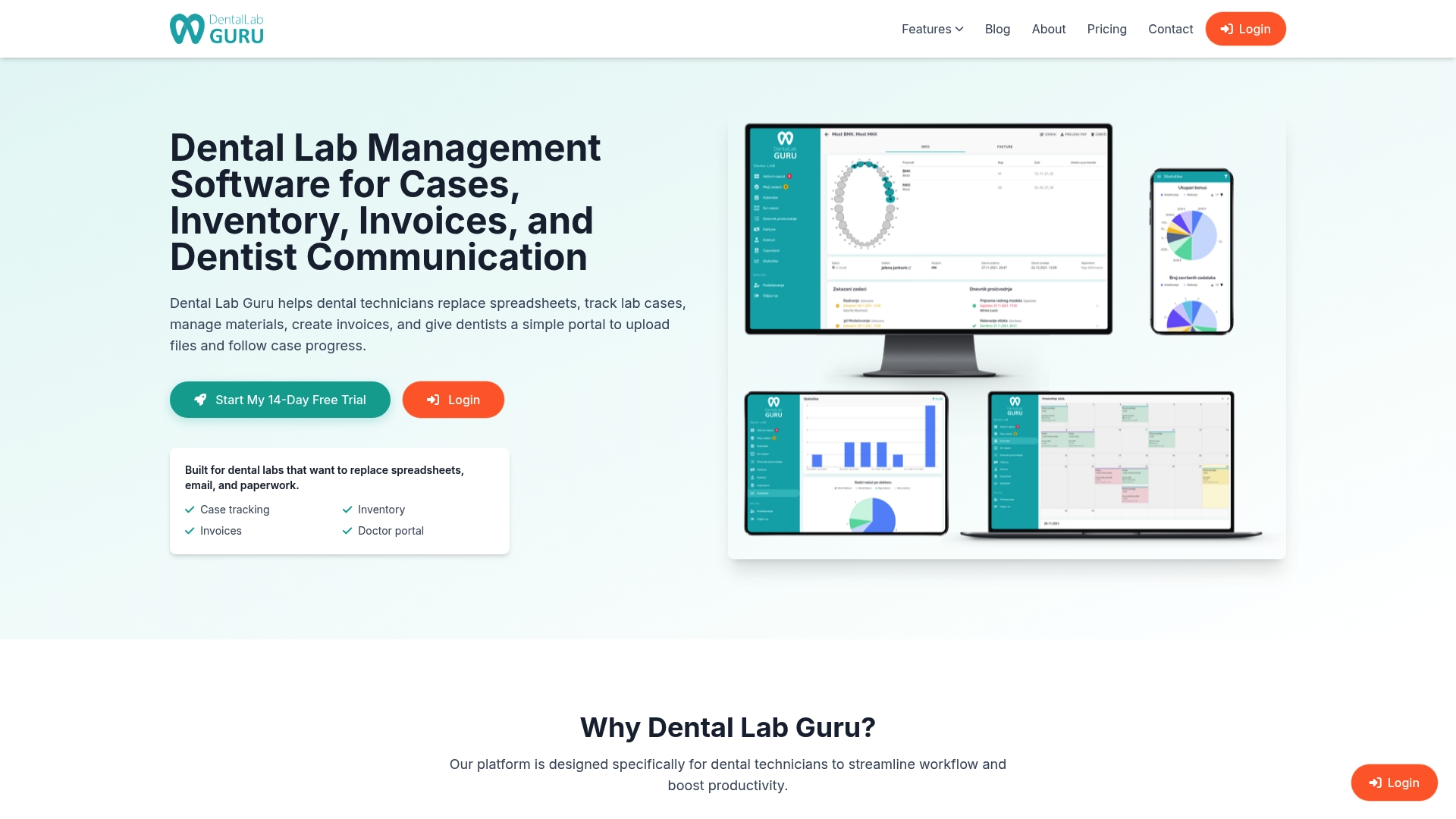
Dental Lab Guru helps dental labs keep cases, clients, deadlines, deliveries, and payments organized in one place. Instead of relying on paper notes, spreadsheets, WhatsApp messages, and memory, your team can work from a clearer case-tracking system.
If purchase orders are part of your workflow, the important thing is simple: every order should connect back to the right case, client, delivery, and invoice. That is what makes the process easier to manage as the lab grows.
FAQ
What is a dental lab purchase order?
A dental lab purchase order is a buyer-issued document that authorizes the purchase of products or services from a dental supplier, specifying quantities, prices, delivery dates, and payment terms. Once accepted by the supplier, it can become part of the commercial agreement between both sides.
How is a purchase order different from a lab invoice?
A purchase order is issued by the buyer before the transaction to authorize a purchase. A lab invoice is issued by the vendor after fulfillment to request payment. Both documents should reference the same PO number for accurate matching.
What should I include in a dental lab purchase order?
Every PO should include buyer and seller contact information, a unique PO number, an itemized list of products or services with quantities and prices, a delivery schedule, and payment terms.
Why do dental labs need both a purchase order and a lab prescription?
The lab prescription provides clinical fabrication instructions for the technician. The purchase order authorizes and documents the financial transaction with the supplier. Both are required for complete clinical and procurement records.
How do I create a purchase order for a dental lab?
Identify the need, draft the PO using a standardized template, confirm pricing and delivery terms, send it to the vendor, and obtain written acknowledgment. Use consistent PO numbering and link each order to its corresponding case record.